

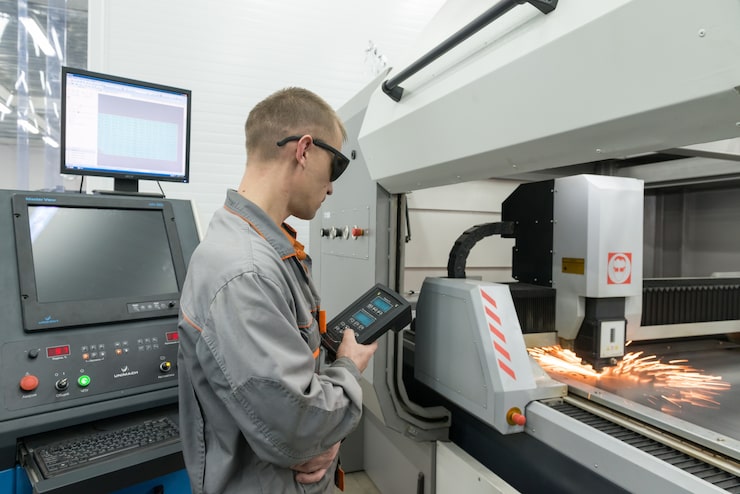
Cut speed often decides whether a plasma cutting operation feels smooth or constantly behind schedule. Faster movement does not always mean better results, and slower passes can waste time and distort edges. Understanding what truly controls cut speed on a plasma cutter helps operators balance productivity with clean, accurate cuts.
The Amperage Setting Used for the Specific Metal Thickness
Amperage directly controls how much energy the plasma arc delivers to the metal. Higher amperage produces more heat, allowing the plasma cutter to melt material faster and move at higher speeds. If amperage is set too low for the plate thickness, the arc struggles to penetrate fully, forcing slower travel to complete the cut.
Matching amperage to thickness also protects cut quality. Excess amperage on thin material can widen the kerf and create heavy dross, even if speed increases. CNC plasma cutting machine setups often rely on amperage charts to maintain the right balance between penetration and speed.
How Conductive Material Type Affects Melt Rate
Different metals melt at different rates even when thickness is identical. Mild steel responds quickly to plasma energy, allowing faster travel speeds. Stainless steel and aluminum behave differently due to their thermal properties and conductivity.
Aluminum, for example, disperses heat rapidly, which can slow effective cutting if parameters are not adjusted. A CNC plasma cutter compensates by modifying speed and power settings based on material type. CNC companies near me often evaluate material behavior before finalizing cut programs.
The Pierce Height Relative to the Work Surface
Pierce height determines how efficiently the arc starts before moving into the cut. Starting too high causes arc instability and wasted energy. Starting too low increases spatter and nozzle wear.
Proper pierce height allows the arc to establish cleanly and transition smoothly into motion. CNC plasma cutting machines automate this process to maintain consistent starting conditions, which directly affects how quickly the torch can accelerate into cutting speed.
Torch Travel Speed Set on the Cnc Control Panel
Torch travel speed defines how fast the cutter moves once the arc is established. Setting this speed too high leads to incomplete cuts or excessive beveling. Too slow, and heat builds up, increasing slag and edge distortion.
CNC plasma cutter controls allow precise speed adjustments for each cut path. Skilled programming ensures that straight cuts, corners, and small features each receive appropriate speed settings. CNC machine company solutions often include optimized speed profiles for complex parts.
The Quality and Pressure of the Assist Gas Supply
Assist gas plays a critical role in removing molten metal from the cut zone. Proper gas pressure helps clear the kerf efficiently, allowing faster torch movement. Inconsistent pressure disrupts the arc and forces slower cutting.
Gas quality matters as well. Moisture or contaminants reduce arc stability and cutting efficiency. Many CNC companies near me emphasize clean, regulated gas systems to maintain consistent cut speeds across long production runs.
How Nozzle Condition Influences Consistent Arc Power
The nozzle shapes and focuses the plasma arc. As it wears, the arc spreads, reducing cutting efficiency. A worn nozzle often forces operators to slow down to maintain cut quality.
Regular inspection and replacement keep arc power concentrated. CNC plasma cutting machines monitor consumable life more closely than manual systems, ensuring that speed does not drop unexpectedly due to degraded components.
The Thickness of the Plate Being Cut in a Single Pass
Thickness sets natural limits on speed. Thicker plate requires more energy to penetrate, which reduces maximum travel speed. Attempting to cut too fast on thick material leads to incomplete separation or heavy dross buildup.
Single-pass cutting depends on system power and material type. High-capacity plasma cutters handle thicker plate at reasonable speeds, while lighter systems require slower movement. CNC machine company recommendations often align system size with thickness requirements to avoid inefficiencies.
How Torch Height Control Maintains Optimal Arc Distance
Torch height control keeps the arc at a consistent distance from the metal surface. Maintaining this gap ensures stable energy transfer and smooth cutting. If the torch drifts too close or too far, arc efficiency drops and speed must be reduced.
Automated height control responds in real time to plate warping and surface variations. A CNC plasma cutter uses this feedback to maintain optimal conditions, allowing higher speeds without sacrificing cut quality. Cut speed depends on more than a single setting. It reflects how power, motion, consumables, and material properties work together during every pass. Amtec Solutions Group designs and integrates plasma cutting systems, CNC automation, and engineered solutions that optimize cut speed, accuracy, and production efficiency across demanding industrial environments.